
Imagine deploying a powerful AI assistant for your enterprise – one that understands your proprietary data and delivers accurate, useful answers – without spending months of trial-and-error development. For many companies, this has been a distant goal. In practice, building AI agents has often felt like solving a Rubik’s cube blindfolded: too many model settings to tweak, no clear way to measure success, and unpleasant surprises when the cloud bill arrives. Promising AI projects frequently stall in endless tuning cycles, with stakeholders losing confidence as teams struggle to evaluate performance. And even when a bot finally works, it might turn out too expensive to scale into production, forcing painful trade-offs between quality and cost.
The Challenge: Why Building AI Agents Is Hard
Enterprises widely recognize the potential of generative AI and large language model (LLM) agents for customer service, analytics, and more. However, three big hurdles have held them back:
- Evaluating AI Quality: How do you know your agent is actually good? Generic benchmarks don’t reflect real business needs. Many teams resort to guesswork or manual reviews, which is slow and unreliable. Building nuanced, domain-specific evaluation metrics has required expensive hand-labeling and expert time.
- Overwhelming Complexity: AI agents aren’t a single model – they’re systems with many components (prompts, retrieval of data, model choice, fine-tuning parameters, etc.). Each component has its own “knobs,” and tuning one can unpredictably affect the others. Teams end up spending months tweaking parameters and prompt wording, akin to trial-and-error.
- Cost vs. Quality Dilemma: Even if you get a working agent, will it be efficient? It’s common to discover that a high-quality solution is prohibitively expensive to run at scale. Some LLM-powered agents can cost dollars per query, which doesn’t fly when you need thousands of queries answered. Teams often face a painful choice: dial down the quality to save costs, or blow the budget.
These challenges keep business leaders up at night. How can we deliver AI solutions that both perform well and make economic sense? This is the gap that Databricks set out to bridge.
Introducing Databricks AI Builder (Agent Bricks)
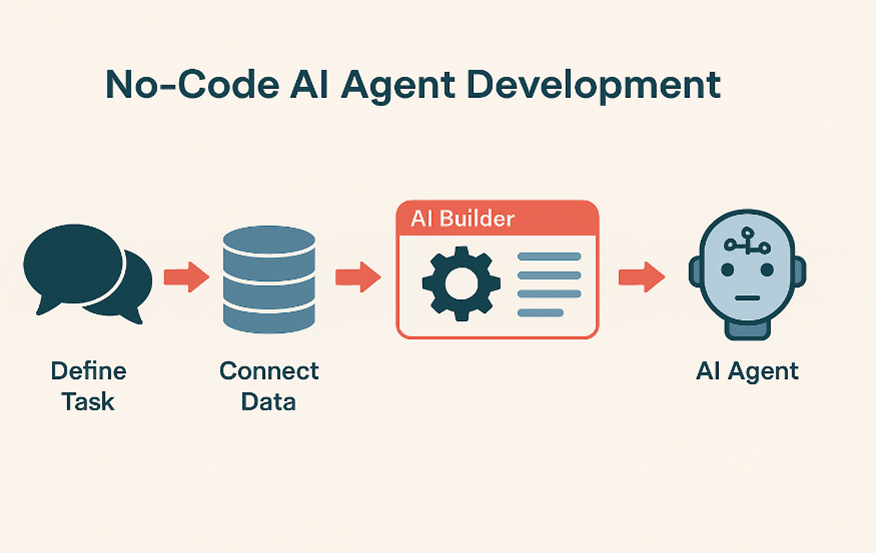
Databricks – known for its unified analytics and AI platform – recently introduced Databricks AI Builder, also known as Agent Bricks, to tackle these exact problems. Think of Agent Bricks as a no-code, auto-pilot system for AI agent development. Instead of manually coding prompts or fine-tuning models, you simply describe what you want the agent to do and point it to your data, and Agent Bricks takes care of the rest.
This new platform automatically handles the heavy lifting of building an AI agent, optimized for your domain and data. The focus shifts from low-level tinkering to high-level guidance. In practical terms, a team can define their agent’s purpose and provide strategic guidance on quality through natural language feedback – and Agent Bricks will generate the needed evaluation suites, tune the models, and balance everything for optimal results.
Crucially, all of this happens without writing code. As one early user from AstraZeneca put it, “with Agent Bricks, our teams were able to parse over 400,000 clinical trial documents and extract structured data points, without writing a single line of code. In just under 60 minutes, we had a working agent” ready for production. This exemplifies the productivity leap AI Builder offers.
Key Features of Databricks AI Builder
What makes AI Builder (Agent Bricks) so powerful? Here are its standout features, explained in plain English:
- No-Code, Guided Development: Build AI agents through an intuitive interface – no programming required. Simply declare your task in natural language and connect your data sources. The platform’s conversational setup enables domain experts to define what the AI should do.
- Automatic Model Tuning & Optimization: Agent Bricks uses Databricks’ Mosaic ML research to find the best model and configuration for your task. It tries different LLMs, adjusts prompts, fine-tunes on your data, and applies advanced techniques like Test-Adaptive Optimization (TAO).
- Data-Grounded Responses (Enterprise Context): Agents are grounded in your enterprise data from day one. Agent Bricks can generate domain-specific synthetic data from your databases and documents to train and test the agent, ensuring accurate, trustworthy responses.
- Built-in Evaluation & Continuous Improvement: Agent Bricks automatically creates custom evaluation benchmarks tailored to your task. As you review outputs and give feedback, the system learns from it over time without requiring re-coding.
- Cost-Efficiency and Scalability: With smart model selection and autoscaling infrastructure, Agent Bricks helps balance quality with cost. The platform optimizes for performance-to-price ratio, supporting usage-based billing and reducing idle infrastructure costs.
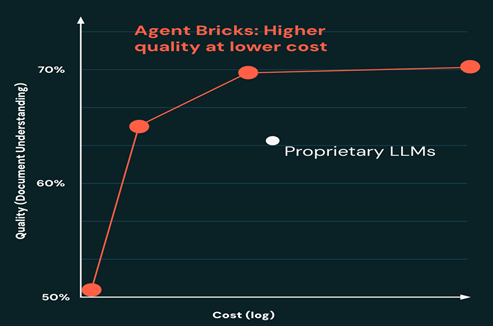
- For document understanding tasks, Agent Bricks delivers higher-quality results at significantly lower cost compared to prompt-optimized proprietary LLMs. In fact, it can outperform these models on document parsing benchmarks while reducing costs by up to 10×.https://docs.databricks.com/generative-ai/ai-builder
Real-World Success Stories
Several organizations have already piloted Databricks AI Builder with impressive results:
- AstraZeneca (Pharmaceuticals): Processed 400,000+ clinical trial documents in under an hour, transforming unstructured text into structured data – all without writing a single line of code.
- Flo Health (Digital Health): Built a health assistant that doubled medical answer accuracy over off-the-shelf models, while meeting strict clinical safety and privacy standards.
- Hawaiian Electric (Utilities): Developed an AI agent that outperformed their original open-source implementation in both accuracy and human evaluation benchmarks.
These examples highlight a common theme: speed and quality at scale. Projects that once took months now go live in days.
How Does AI Builder Compare to Other Platforms?
Other platforms like Amazon Bedrock, Google Vertex AI, and Microsoft Azure AI Studio offer tools for generative AI development. However, Databricks stands out with its end-to-end, data-centric approach:
- Fully integrated no-code interface with automatic optimization and evaluation.
- Grounded in enterprise data with first-class governance via Unity Catalog.
- Seamless deployment, scaling, and monitoring through the Databricks Lakehouse platform.
While other platforms often require assembling tools and writing code to fine-tune models or manage evaluations, Agent Bricks does it all in one platform.
The Road Ahead: No-Code AI and the Future of Enterprise AI
We’re entering an era where building AI solutions is less about coding and more about strategic orchestration. Business leaders and product managers define what the AI should achieve, and the platform handles the rest. Databricks AI Builder is a significant step in this direction.
Already, customers are seeing development timelines reduced from weeks to days, with performance doubling on some benchmarks. It’s not just about getting an AI model live – it’s about making sure it’s the right model, built efficiently, grounded in your data, and ready for production.
Conclusion & Call to Action
Databricks AI Builder (Agent Bricks) shows that it’s possible to build high-quality, domain-specific AI agents quickly and cost-effectively. By automating model optimization and grounding AI in enterprise data, teams can focus on defining the business problem – not managing infrastructure.
If you’re exploring AI initiatives, now is the time to consider how no-code platforms like AI Builder can accelerate your roadmap.
References:
- Databricks AI Builder Documentation: https://docs.databricks.com/generative-ai/ai-builder
- Databricks Blog – Agent Bricks Overview
- Mosaic ML / Databricks Research on TAO and Synthetic Evaluation
- Databricks Data + AI Summit 2025 Keynote Highlights
- Case Studies: AstraZeneca, Flo Health, Hawaiian Electric, Experian, NDUS (via Databricks blog and public sessions)

Hadi Amiri
Hadi Amiri is a versatile Deep Learning Engineer and Data Scientist specializing in machine learning, natural language processing (NLP), and cloud-based AI solutions. With a master's degree in electrical and computer engineering, Hadi has excelled in designing and deploying end-to-end AI pipelines, optimizing ETL processes, and building advanced retrieval-augmented generation (RAG) systems. His expertise spans generative AI, uncertainty quantification, and predictive modeling, delivering innovative solutions for industries such as technology, healthcare, and telecommunications. Hadi's ability to lead multidisciplinary teams and translate complex technical challenges into scalable AI architectures makes him a valuable contributor to cutting-edge enterprise transformation